Back to projects

ONGOING LAB RESEARCH · QUADRUPED ROBOTICS

TerraGoat: A 15-DOF Quadruped with an Active Spine

面向陡峭地形的 15 自由度主动脊柱仿生四足机器人

TerraGoat is a goat-inspired research platform for steep slopes and sparse footholds. An active spine changes body configuration and center-of-mass distribution, while interchangeable feet, modular hardware, and a ROS 2 foundation support research into coordinated spine–limb climbing.

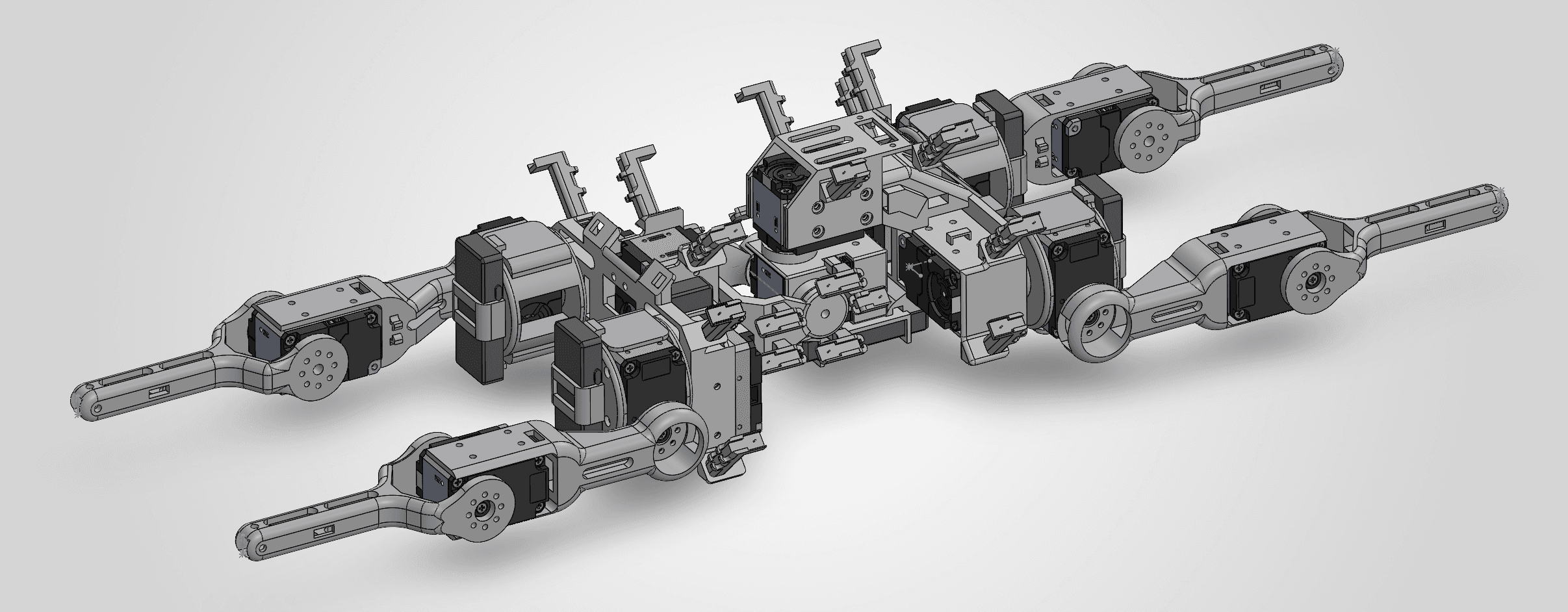
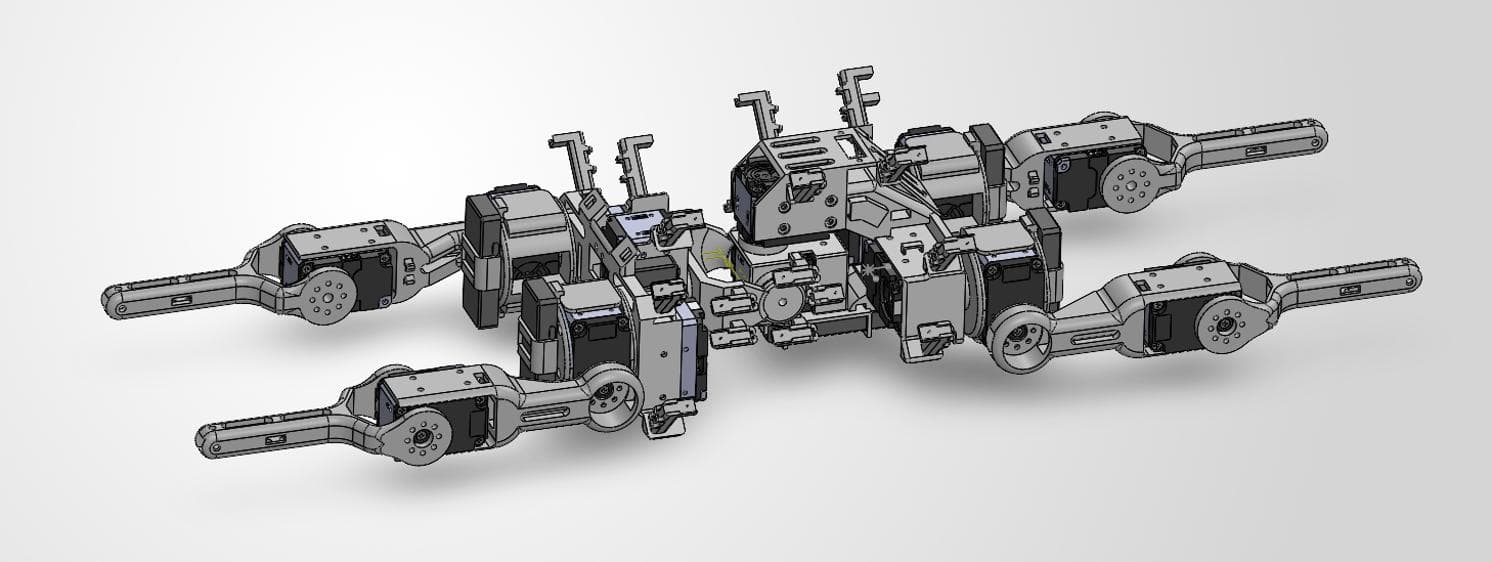
TerraGoat full quadruped CAD assembly in flattened pose
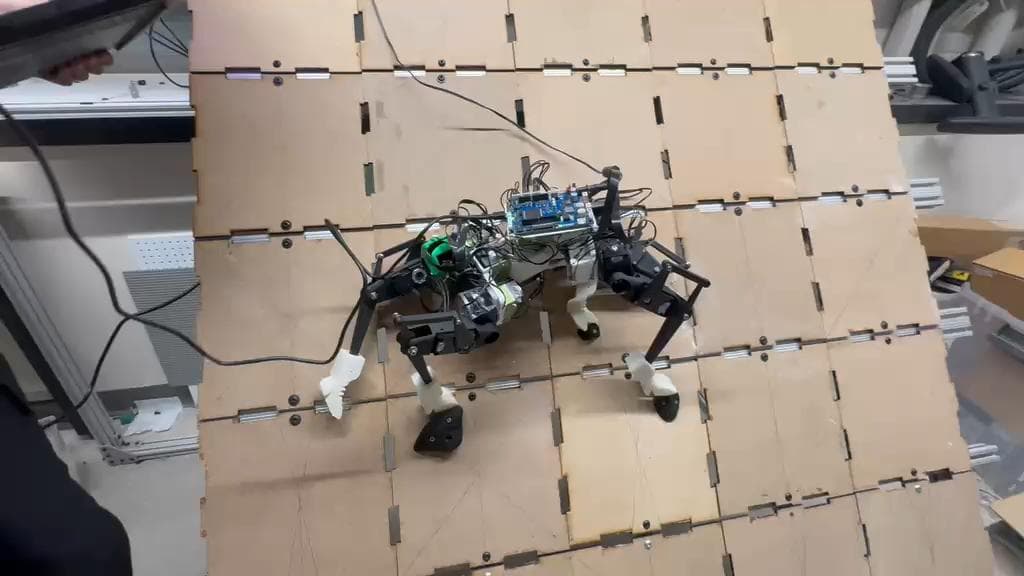
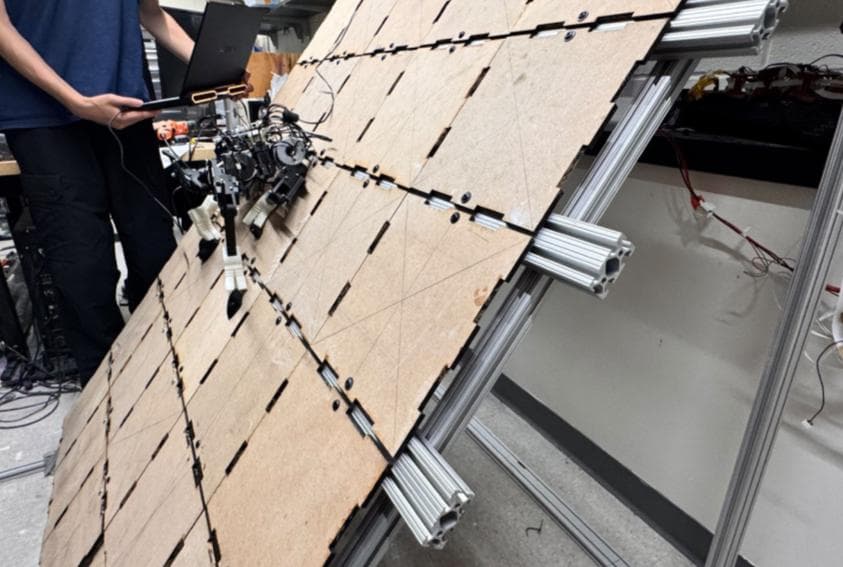
Open-loop climbing test on an adjustable incline
PHYSICAL PROTOTYPE
Collaborative lab research
Mechanical design · Additive manufacturing · Systems integration · ROS 2 modeling · Open-loop testing
TECH STACK
SolidWorks · Additive Manufacturing · ROS 2 Jazzy · URDF/Xacro · C++/Python · OpenCR/IMU · Isaac Lab/MuJoCo · PyTorch

Internal laboratory project

Source code and internal documentation cannot be shared. This page presents only approved system design, research goals, and project-stage information.

Research question

Rigid-trunk quadrupeds must rely almost entirely on their limbs for center-of-mass transfer and foot repositioning on steep terrain. TerraGoat makes the body itself a controllable kinematic chain, asking whether active-spine motion can expand reachable workspace, preserve contact, and improve resistance to tipping.

System objectives

  • Build a maintainable 15-DOF physical quadruped with an active spine and serviceable joint, wiring, and power layouts.
  • Establish URDF/Xacro, kinematics/dynamics, and ROS 2 hardware-interface foundations with shared semantics across simulation and hardware.
  • Identify foothold contact, friction, and structural uncertainty on an adjustable slope to define measured simulation parameter ranges.
  • Ultimately learn the coupling between active-spine adjustment and limb gait for stable center-of-mass transfer on steep terrain.

15 DOF

Limbs and active spine

ROS 2

Modular control stack

3D Print

Rapid structural iteration

RL

Spine–limb roadmap

The platform combines modular joints with additive-manufactured structures for rapid iteration around steep-contact tasks. The design treats spine deformation, foot contact, and cable routing as quantities that must later enter control and identification—not as isolated mechanical details.

TerraGoat full quadruped CAD assembly in flattened pose
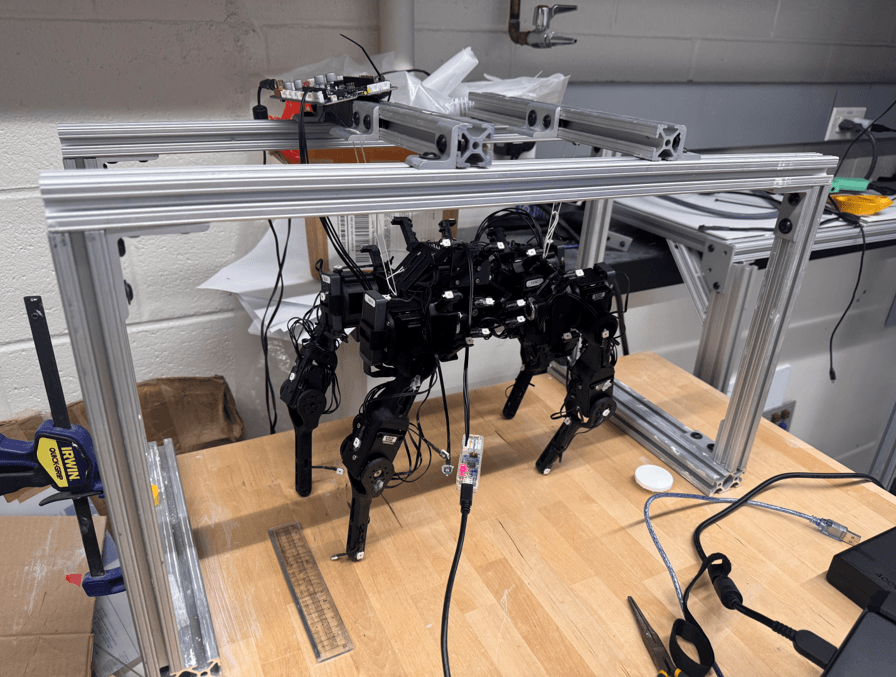
Physical assembly and cabling inside the aluminum test rig
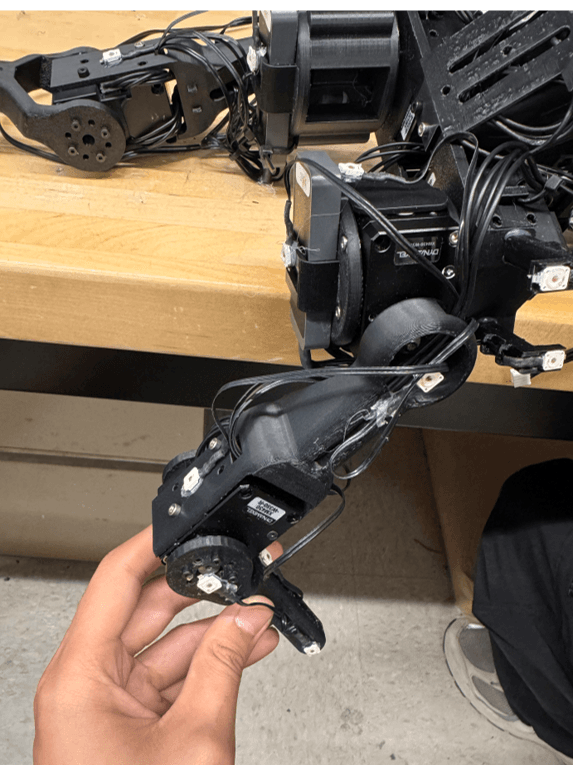
Close-up of the Dynamixel multi-joint leg mechanism

Active-spine mechanism

Controllable joints between the front and rear body sections adjust trunk curvature, reachable foot workspace, and center-of-mass location.

Structure & material iteration

3D printing accelerates geometry tests, while infill and engineering materials are tuned at load-critical parts to balance stiffness and mass.

Embedded cable topology

Communication and power routes are integrated into the mechanism to reduce entanglement through spine and leg motion while preserving service access.

Interchangeable goat-inspired feet

Split-toe geometry and contact pads test stepping/catching and spread-grip modes while supporting friction calibration.

Offline policy learning is separated from physical execution. Simulation handles physics alignment, domain randomization, and training; the host runs ROS 2 motion/spine nodes and ros2_control, maps target joint angles to 15 servos, and reads IMU and joint feedback.

OFFLINE

Simulation & Training

Isaac Lab / MuJoCo · PyTorch · PPO

HOST PC

Motion & Spine Nodes

Raspberry Pi / Jetson · Ubuntu · ROS 2

CONTROL

ros2_control

Hardware interface · Target joint angles

ROBOT

Actuation & Feedback

15× servos · OpenCR IMU · Joint states

PPO / PyTorch

Policy training

ROS 2 / OpenCR

Runtime interface

IMU / Joint State

State feedback

The project is currently in the physical-platform buildout and control-foundation phase. The 15-DOF active-spine prototype, wiring and hardware layout, ROS 2/URDF model, and open-loop motion tests are complete; upcoming work focuses on simulation–physics alignment and PPO-based spine–limb climbing control.

Complete

15-DOF mechanical prototype

The active spine, limbs, modular joints, CAD assembly, fabrication, and physical integration are in place.

Integrated

Wiring & hardware layout

Servo, communication, power, and onboard-controller layouts have been assembled with cable-entanglement iterations.

Foundation ready

ROS 2 & robot model

The modular ROS 2 node structure, hardware interface, URDF/Xacro model, and initial kinematic/dynamic derivations have been established.

Validated

Open-loop motion tests

Open-loop gait and joint-target tracking tests provide data for action mapping, response-delay measurement, and state-noise analysis.

Planned

Learning-based climbing

PPO-based spine–limb climbing control is the next stage and remains in planning and learning-environment preparation.

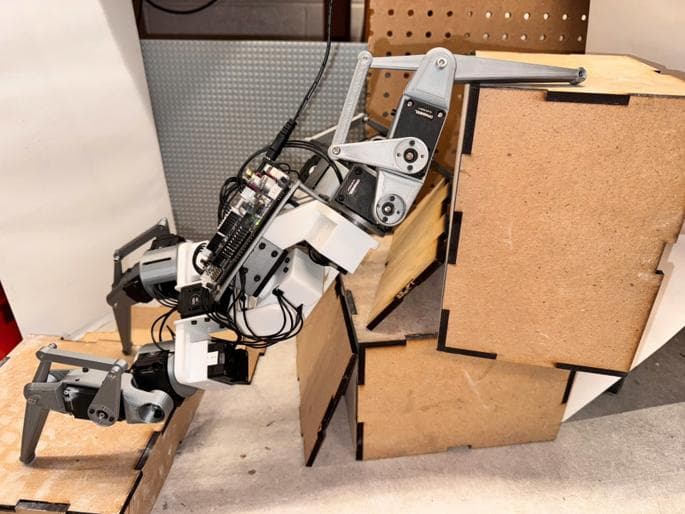
Open-loop climbing test on an adjustable incline
Top view of the TerraGoat physical prototype
Open-loop climbing test on an adjustable incline

Open-loop testing & identification

Physical experiments primarily establish credible parameter ranges for the future learning environment; they do not yet demonstrate autonomous climbing.

01

Action-space mapping

Measure angle/velocity command tracking across 15 joints, actuator response delay, and usable output boundaries.

02

State-space profiling

Characterize IMU attitude/rate, joint feedback, and the influence of printed-spine deformation on center-of-mass estimation.

03

Kinematic consistency

Compare measured joint angles with the URDF/Xacro model and inspect coordinated spine–limb workspace.

04

Contact & uncertainty

Measure foot-slip thresholds on the slope and estimate mass-distribution error, cable tension, and spine damping ranges.
The planned PPO policy coordinates active spine and limb motion rather than replacing all low-level control. It outputs target joint angles for execution by lower-level PD and hardware controllers.

01

Simulation–physics alignment

Rebuild the robot and steep terrain in Isaac Lab or MuJoCo, injecting measured IMU noise, motor delay, mass error, and contact parameters into domain randomization.

02

State & action spaces

Observe IMU, 15-DOF joint positions/velocities, foot contacts, and spine pose; define actions as target angles for low-level joint controllers.

03

Multi-objective reward

Balance climbing progress, center-of-mass stability, contact retention, and energy/torque penalties.

04

Policy validation & transfer

Run ablations and robustness tests in parallel simulation before staged hardware deployment and external pose/trajectory validation.